
Here’s a clear, structured explanation of what AI is, the different forms of it, and how each compares in strengths and weaknesses for real-world applications.
What Is AI?
Artificial Intelligence (AI) refers to systems or machines that perform tasks normally requiring human intelligence—such as reasoning, learning, problem-solving, understanding language, visual perception, and decision-making.
At its core, AI is about creating algorithms that can sense, interpret, act, and learn—often improving with more data.
Major Forms of AI
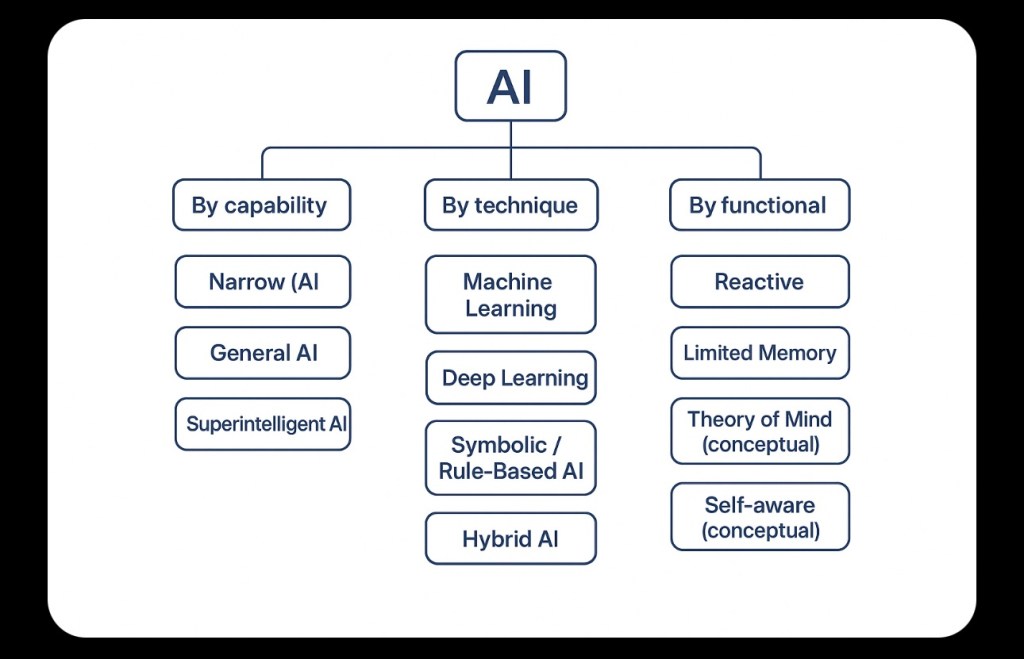
AI is usually described using three main taxonomies:
By capability Narrow (Weak) AI General AI Superintelligent AI By technique Machine Learning (ML) Deep Learning (DL) Symbolic / Rule-Based AI Hybrid AI By functional type Reactive Limited Memory Theory of Mind (conceptual) Self-aware (conceptual)
Below is a practical combined view focused on how AI is actually used, what each type is good for, and where it struggles.
1. Narrow (Weak) AI
What it is
Systems designed to perform one task very well—like image recognition, translation, or playing chess.
Examples
ChatGPT Google Maps route optimization Medical imaging classifiers Spam filters Recommendation systems (Netflix, Amazon)
Strengths
Extremely good at specific tasks Trained on massive datasets Often more accurate than humans in narrow domains Scalable and cost-effective
Weaknesses
Cannot generalize outside their domain No common sense or understanding Can fail in surprising ways Dependent on data quality and quantity
Best applications
Pattern recognition (vision, speech, fraud detection) Automation of repetitive cognitive tasks Industrial optimization, robotics, logistics
2. Artificial General Intelligence (AGI)—Conceptual / Emerging
What it is
A hypothetical system able to perform any intellectual task a human can, with flexible reasoning and common sense.
Strengths (theoretical)
Can generalize from one domain to another Robust problem solving Could autonomously plan, adapt, and self-correct Doesn’t break when conditions change
Weaknesses (current reality)
Not achieved yet Hard to control, align, or interpret Requires vast computational resources Risks unclear and widely debated
Best applications (future)
Complex autonomous decision-making Scientific discovery Multi-domain personal assistants Robotics that understand real-world context
3. Machine Learning (ML)
What it is
Algorithms that learn patterns from data without being explicitly programmed.
Common types
Supervised learning (labelled data → predict outputs) Unsupervised learning (find structure in data) Reinforcement learning (learn via trial-and-error rewards)
Examples
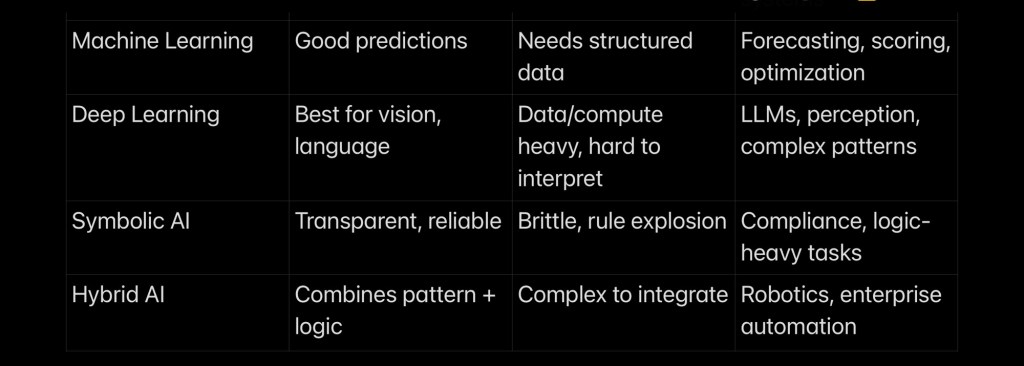
Credit scoring Predictive maintenance Anomaly detection Weather forecasting
Strengths
Adaptable to many data types Good for prediction and classification Often interpretable (for simpler ML models)
Weaknesses
Requires lots of cleaned, structured data Struggles with unstructured data (images, language) unless paired with deep learning Susceptible to bias
Best applications
Forecasting Optimization Risk scoring Moderate-complexity automation
4. Deep Learning (DL)
What it is
A subset of ML using large neural networks with many layers—excellent at handling unstructured data.
Examples
Large language models (GPT, Gemini, Claude) Computer vision (self-driving car perception) Speech recognition Protein structure prediction (AlphaFold)
Strengths
State-of-the-art performance in many tasks Good at abstraction (patterns humans can’t see) Works with messy, large datasets
Weaknesses
Data-hungry and computationally expensive Often “black boxes”—hard to understand their reasoning Vulnerable to adversarial examples Hallucinates or makes confident errors
Best applications
Vision Speech Language Scientific discovery High-dimensional pattern recognition
5. Symbolic / Rule-Based AI
What it is
AI that uses predefined logic rules and knowledge graphs rather than learned patterns.
Examples
Expert systems (medical diagnosis systems in the 1980s) Tax software Logic-based planning tools Knowledge bases (Wolfram Alpha)
Strengths
Transparent and interpretable Good for legal, regulatory, or safety-critical logic Needs less data Easy to validate and audit
Weaknesses
Doesn’t scale well—rules explode in complexity Brittle—breaks when rules miss edge cases Cannot learn from data
Best applications
Finance compliance Safety-critical decision support Deterministic workflows Data-quality enforcement
6. Hybrid Systems (Neuro-Symbolic AI)
What it is
Combines deep learning (pattern recognition) with symbolic logic (structured reasoning).
Examples
Robotics navigation with perception + rules AI assistants using LLMs + deterministic logic IBM neuro-symbolic systems for enterprise workflows
Strengths
Better reasoning than pure DL More reliable and interpretable Handles uncertainty while enforcing constraints Can use smaller datasets
Weaknesses
Hard to design Integrating two paradigms can be complex Still a young field
Best applications
Robotics Enterprise automation Science (where both learned patterns and logical constraints matter)
Key Takeaway
AI isn’t one thing—it’s a spectrum of methods. The right choice depends entirely on the data, the problem, the need for reliability, and whether interpretability or flexibility matters more.
Summary


Didn’t allow delete of duplicates.
 Data Process Insights LLC
Leave a comment