Generated by ChatGPT and edited
Early Foundations of British Rule & Resistance
1757 – Battle of Plassey – British East India Company gains political control in Bengal.
1764 – Battle of Buxar – Consolidates British power in northern India.
1817–1818 – Third Anglo-Maratha War – Defeat of Maratha Confederacy, extending British dominance. 1857 – First War of Independence (Sepoy Mutiny) – Widespread rebellion; failed but became a symbol of resistance.
Rise of Organized Nationalism
1876 – Formation of the Indian Association – One of the earliest political organizations of educated Indians.
1885 – Formation of the Indian National Congress (INC) – Initially moderate in its demands.
1905 – Partition of Bengal – Triggered Swadeshi Movement, boycotts, and promotion of indigenous industry.
1906 – Formation of the All-India Muslim League – Initially pro-British, later played a key role in partition politics.
1907 – Surat Split – Moderates and Extremists within INC split over methods of struggle.
1911 – Partition of Bengal annulled – Seen as a victory for nationalist agitation.
Gandhian Era & Mass Movements
1915 – Mahatma Gandhi returns from South Africa – Brings ideas of satyagraha (nonviolent resistance). 1916 – Lucknow Pact – Hindu-Muslim unity agreement between INC and Muslim League.
1917 – Champaran Satyagraha – Gandhi’s first successful mass struggle in India, helping indigo farmers.
1919 – Jallianwala Bagh Massacre – British troops kill hundreds in Amritsar; fuels national outrage. 1919 – Montagu-Chelmsford Reforms & Rowlatt Act – Reforms seen as inadequate; Rowlatt Act sparks protests.
1920–22 – Non-Cooperation Movement – Boycott of British goods, institutions; ends after Chauri Chaura violence.
1927 – Simon Commission Protests – “No Indian members” leads to nationwide protests; slogan “Simon Go Back” gains popularity.
1928 – Nehru Report – First major constitutional proposal by Indians for self-government. 1929 – Lahore Session of INC – Purna Swaraj (Complete Independence) adopted as the goal.
1930 – Salt March (Dandi March) – Civil disobedience against salt tax; inspires nationwide participation.
1931 – Gandhi-Irwin Pact – Temporary suspension of civil disobedience.
Towards Final Struggle
1940 – Lahore Resolution – Muslim League calls for separate nation for Muslims (Pakistan demand). 1942 – Quit India Movement – Gandhi calls for immediate end to British rule; mass arrests and repression follow.
1943 – Subhas Chandra Bose’s INA – Indian National Army fights alongside Japanese forces in WWII. 1945 – INA Trials – Public sympathy for INA officers boosts nationalist sentiment.
1946 – Naval Mutiny – Indian sailors revolt in Bombay and other ports; shows weakening British control.
1946 – Cabinet Mission Plan – British attempt to negotiate transfer of power fails to reconcile INC and Muslim League fully.
Independence & Partition
3 June 1947 – Mountbatten Plan – Announces partition of British India into India and Pakistan.
15 August 1947 – Independence of India – Jawaharlal Nehru becomes first Prime Minister; partition leads to massive communal violence and migration.

The National Anthem
India’s national anthem, “Jana Gana Mana”, was composed by Rabindranath Tagore in 1911 in Bengali. First sung at the Calcutta Session of the Indian National Congress, it was originally written in highly Sanskritized Bengali and praised the unity and diversity of India under the guidance of a divine charioteer — representing the spirit of the nation rather than any specific ruler.
Note that the version below is the original composition called Bharato Bhagya Vidhaata in Bengali by the Nobel Laureate Ravindranath Tagore from which the official version of the national anthem was produced.
This complete version is far more expansive in its imagery than the official anthem, moving from a geographic celebration of India to an almost spiritual hymn to resilience, unity, and renewal.
Full English Translation (Poetic Rendering)
Verse 1
Hail to thee, ruler of the people’s minds,
O dispenser of India’s destiny!
Thy name awakens hearts in Punjab, Sindh, Gujarat, and Maratha,
In Dravida, Utkal, and Bengal.
It resounds in the Vindhyas and the Himalayas,
Flows with the Yamuna and the Ganga,
And swells with the ocean’s waves.
In thy blessed name they rise,
In thy grace they seek their light,
Singing thy eternal praise.
Victory, victory, victory to thee.
Verse 2
O remover of misfortune, reliever of sorrow,
Thy mercy is the song eternal.
Ever thou callest us forward,
Standing guard along the path.
We mingle the dust of the traveller’s feet
With the banner thou liftest high;
Tears as offerings, blood as garlands,
We lay upon thy gracious altar.
Verse 3
Thou hast fulfilled our solemn vows,
Thou hast quieted our wrath.
Thou showest the way with light
When darkness closes around.
Bearing the thunderbolt in thy hand,
Thou guardest us evermore;
Amid the ruins wrought by the enemy’s attack,
Thou standest as our steadfast hope.
Verse 4
In our days of sorrow and hardship,
Ever thou art our companion.
In storms of destruction and restless tides,
Thou hast kept the boat from harm.
In darkness thou art the morning sun,
Awakening new life within.
In danger thou givest us courage,
Thou art the spirit of the unconquerable.
Verse 5
At the day’s end thou lightest the lamp,
Glorifying the night.
Age after age thou awakenest in our hearts
The hope that is ever new.
Even after destruction thou buildest again
The stairway to new life.
Victory, victory, victory to thee.
The Flag, design, symbolism, and historical significance
🇮🇳 Design
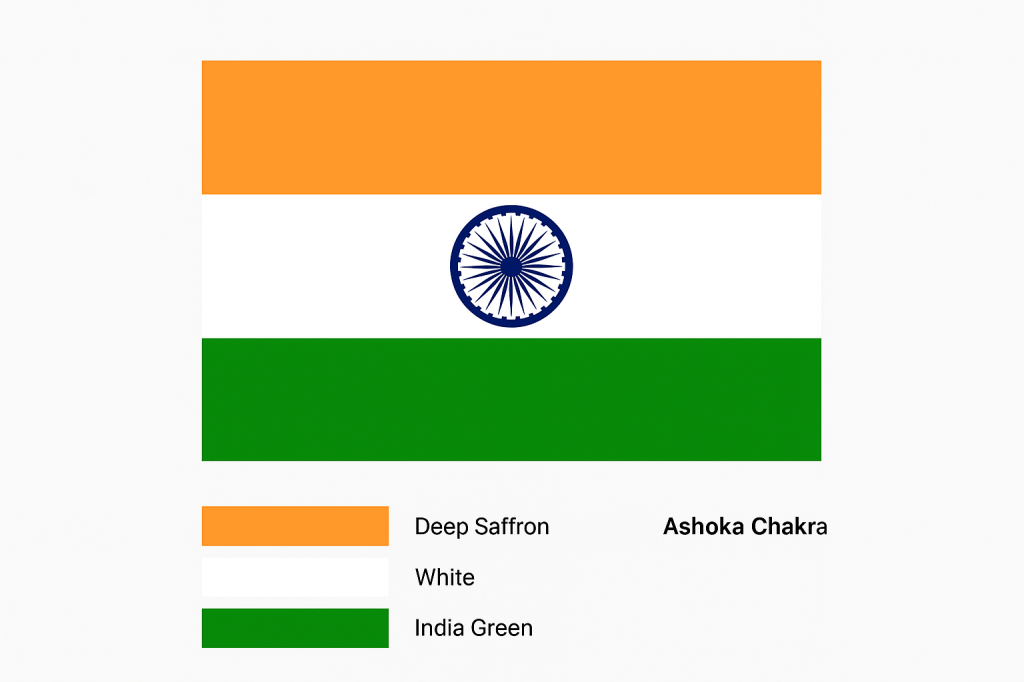
Shape: Horizontal tricolour, proportion 2:3 (length to height).
Colours (from top to bottom): Deep Saffron (Kesaria) – Hex: #FF9933 White – Hex: #FFFFFF India Green – Hex: #138808
Centerpiece: Navy blue Ashoka Chakra (wheel) in the white band. 24 equally spaced spokes. Diameter approximately the height of the white band.
Material (officially for ceremonial use): Hand-spun and hand-woven cotton, silk, or wool khadi, as per the Bureau of Indian Standards specifications.
Symbolism
Saffron (Top band) – Courage, sacrifice, and the spirit of renunciation.
White (Middle band) – Truth, peace, and purity. Green (Bottom band) – Prosperity, fertility, and faith.
Ashoka Chakra – Represents the eternal wheel of law (Dharma Chakra) from Emperor Ashoka’s Sarnath Lion Capital; the 24 spokes symbolize justice, movement, and progress. Movement is key — a reminder that India must constantly progress or risk stagnation.
Historical Significance
Pre-Independence Evolution:
1906 – Early nationalist flag with green, yellow, and red bands and symbols.
1921 – Pingali Venkayya presented a two-colour (red and green) design; Gandhi suggested adding a white stripe and spinning wheel (charkha).
1931 – Adopted a tricolour (saffron, white, green) with a charkha — a direct precursor to the current flag.
1947 – Final adoption: On 22 July 1947, the Constituent Assembly adopted the present design, replacing the charkha with the Ashoka Chakra to represent a broader national philosophy beyond one movement. First hoisted officially on 15 August 1947, the day of independence.
Protocol & Respect
The Flag Code of India governs its display and usage. Must never touch the ground or be used for commercial purposes. Khadi flags are the only ones allowed for official use — a nod to Gandhi’s Swadeshi movement.
 Data Process Insights LLC
Leave a comment